
Growing Restrictions on Weight Loss Content
Social media platforms, including TikTok, have significantly increased restrictions on content related to weight loss treatments particularly GLP 1 medications such as Mounjaro (tirzepatide) and Wegovy (semaglutide). Similar restrictions are also affecting content about other GLP 1 medications such as liraglutide.
These changes are officially positioned as patient safety measures aimed at reducing misleading health claims. In practice, they are also limiting access to valuable, compliant health information including patient experiences, safety guidance, and content from regulated providers like Health Wise.
What Is Being Restricted?
Content containing specific terms associated with GLP 1 medications is increasingly removed, suppressed algorithmically, or prevented from being amplified. Affected content includes posts referencing:
- Mounjaro and tirzepatide.
- Wegovy and semaglutide.
- Weight loss treatments and GLP-1 receptor agonists more broadly.
- Provider comparisons, pricing discussions, and treatment access.
The restrictions apply inconsistently. Content that is clearly commercial or misleading is the intended target but automated enforcement tools are poorly calibrated, and a significant volume of educational content is caught in the same net.
What Patients Are Losing
The practical consequence for patients is a reduction in access to peer level information many people rely on when navigating new treatments. This includes:
- Real patient experiences that help set realistic expectations about side effects, outcomes, and timelines for treatments like Mounjaro and Wegovy.
- Safety warnings about unregulated providers. Our guide on how we verify UK pharmacies explains why this matters.
- Honest, first-hand discussions about the difficulties of access, cost, and treatment continuation.
- Content from regulated smaller clinics and comparison platforms that operate within the law.
When this content disappears, the vacuum is not filled by better sources. It is often filled by unverified content that evades detection by avoiding flagged terms precisely the opposite of what moderation intends.
The Role of UK Regulation
In the UK, the Medicines and Healthcare products Regulatory Agency (MHRA) enforces advertising standards for prescription medicines under the Human Medicines Regulations 2012. These regulations prohibit the direct advertising of prescription only medicines (POMs) to the general public.
This means a commercial clinic cannot run an advertisement promoting Mounjaro to a consumer audience. However, there is an important legal distinction:
- Advertising — Promoting a specific prescription product for commercial gain. Prohibited under the MHRA advertising rules.
- Education — Providing factual information about a treatment, its effects, or its regulatory status. Permitted, and what platforms like Health Wise do.
- Patient discussion — Sharing personal treatment experiences in a non-commercial context. Generally permitted.
Platforms applying blanket keyword restrictions are, in many cases, suppressing content that falls well within legal boundaries.
The Problem With Over-Moderation
Removing genuinely misleading content is legitimate and necessary. The problem arises when moderation is so broad that it also removes content that serves patients well. Excessive restriction can:
- Limit patient access to education about treatments they are already taking or considering.
- Reduce the peer support networks that help patients manage side effects and expectations.
- Suppress compliant providers whose content is legitimate but triggers automated keyword filters.
- Create an asymmetry where well-resourced organisations can work around restrictions, while smaller and independent voices cannot.
There is also a paradoxical risk: when legitimate information becomes harder to find, patients may turn to less accurate or less regulated sources precisely the outcome that moderation is meant to prevent. This is why platforms like Health Wise that verify content quality and pharmacy compliance matter more, not less, in a restricted information environment.
Commercial Influence and Market Competition
The GLP 1 weight loss treatment market in the UK is highly competitive. Smaller digital clinics often offer faster access, lower prices, and more flexible service models than established providers.
This competitive dynamic creates an additional concern: that content suppression may not be driven exclusively by safety priorities. There are growing questions about whether:
- Larger providers with significant commercial influence are better positioned to shape platform policies.
- Smaller competitors are disproportionately affected by content restrictions that their larger rivals are better equipped to navigate.
- Commercial pressure is playing a role alongside genuine safety concerns in moderation decisions.
These concerns warrant scrutiny. Moderation that primarily disadvantages smaller, independent providers should be examined for competitive fairness as well as safety effectiveness.
Uneven Enforcement Concerns
Reports from regulated providers and patient advocacy groups suggest that enforcement of content restrictions has not been applied consistently:
- Smaller clinics and independent practitioners face more frequent content removal than established providers.
- Content from larger organisations remains accessible even when it is substantively similar to removed content from smaller sources.
- Appeal processes are slow, opaque, and difficult to navigate—particularly for individuals and small businesses.
Uneven enforcement does not simply limit harmful content it systematically disadvantages certain providers while leaving the broader information landscape unchanged. Independent, regulated comparison platforms become more important in this environment.
Impact on Patients
The cumulative effect of broad content restrictions on patients is significant:
- Reduced access to reliable, peer-level information about treatments like Mounjaro and Wegovy they may already be using.
- Greater exposure to misinformation from sources that avoid flagged terms by using obfuscating language.
- Difficulty identifying safe, regulated providers. Our pharmacy verification guide explains what to look for.
- Loss of the informal safety net that patient communities provide—particularly around early side effect identification.
Patients navigating weight loss treatment decisions deserve better access to accurate information, not less.
What Patients Need
Effective moderation and genuine patient safety are not mutually exclusive but they require more precision than keyword blocking delivers. What patients need is:
- Access to accurate, evidence-based information about GLP-1 treatments and their effects.
- Clear pathways to safe, regulated providers who operate within UK law.
- Transparent pricing and service information that enables meaningful comparison.
- Peer support spaces where real patient experiences can be shared honestly.
Platforms have a role to play in protecting patients from misinformation. But moderation must preserve the content that genuinely helps people.
Where to Find Reliable Information
If you are seeking trustworthy guidance on GLP 1 treatments, use regulated and verified sources:
- NHS — Wegovy (semaglutide) and NHS — Mounjaro (tirzepatide) for clinical information.
- The MHRA for regulatory information and medication safety updates.
- Your GP or a regulated UK prescriber for personalised clinical advice.
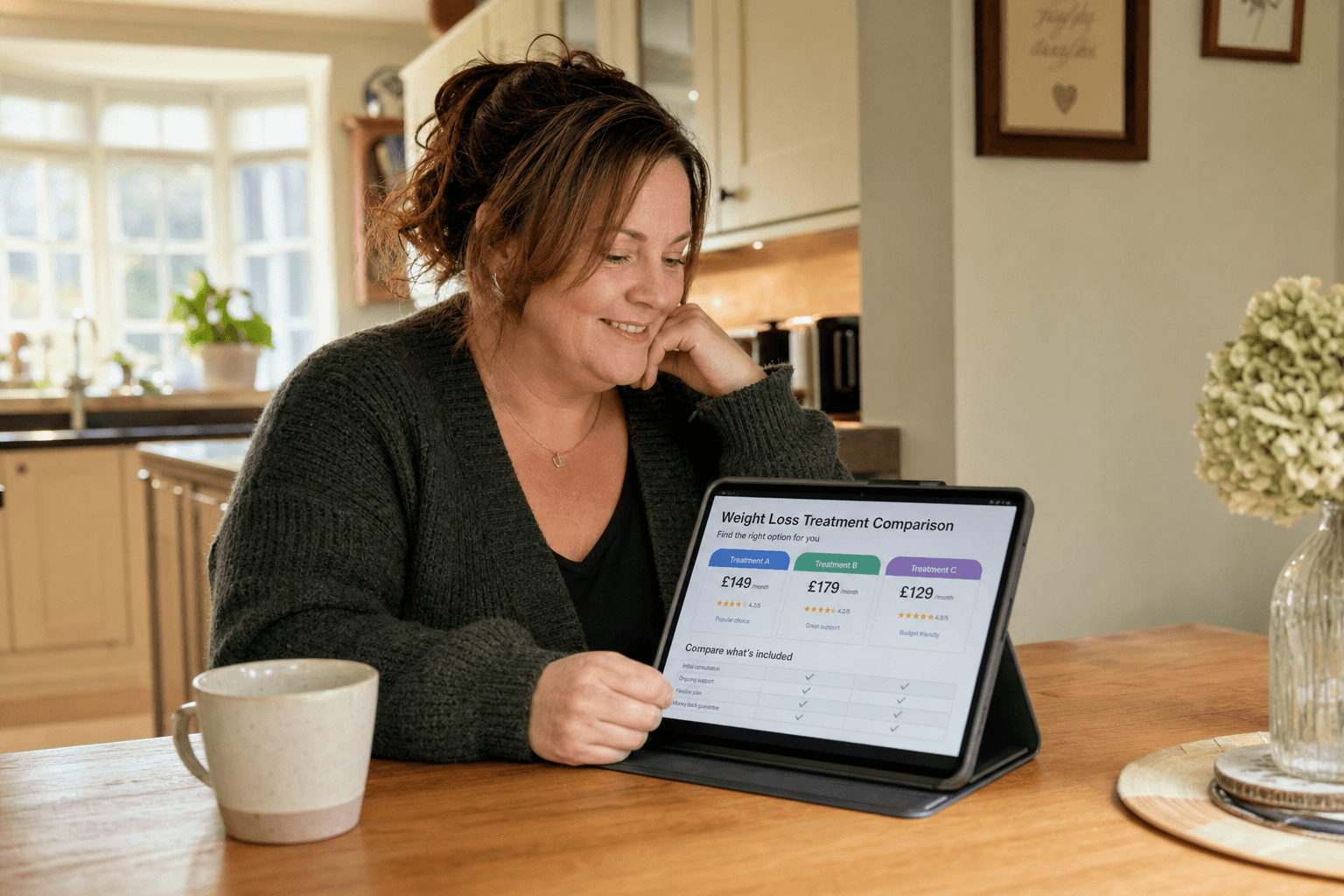
- Health Wise — a regulated comparison platform that verifies every pharmacy it lists and follows UK healthcare communication standards. Start with our treatment comparison or browse the helpful guides hub.
Related Guides
Browse more topics in our helpful guides hub.
Sources & Further Reading
This guide references the following official and authoritative sources.
- 1MHRA — Human Medicines Regulations 2012
The UK legal framework governing the advertising and promotion of prescription-only medicines to the public.
- 2MHRA — Guidance on advertising medicines
Official MHRA guidance on what constitutes permissible and prohibited promotion of prescription medicines in the UK.
- 3NHS — Wegovy (semaglutide) information
NHS clinical information on Wegovy, including how it works, prescribing criteria, and patient safety guidance.
- 4NHS — Tirzepatide (Mounjaro) information
NHS clinical information on Mounjaro, including side effects, dosing, and important safety considerations.
- 5GPhC — Registered pharmacy standards
The standards that registered UK pharmacies must meet, relevant to patients assessing the legitimacy of online providers.
- 6Helpful guides hub — Health Wise
Browse independent UK guides on GLP-1 medications, pharmacy safety, and weight-loss support.
- 7What is Wegovy? Full guide — Health Wise
Independent guide to Wegovy (semaglutide) — how it works, expected outcomes, and verified UK pricing.